Stay Awesome

Tetanus
Find most of the information you need in these resources
Always refer to your local signed PGD's in practice, and remember the Green Book takes priority over the SPmC - and sometimes WHO takes priority over the Green Book! They don't always say the same!






Recent Updates & News
29th Jan: The Td/IPV school leaver vaccine coverage data was published today for 2024-2025. Like with the HPV patterns, London has had some of the worst uptake (as low as 64.8%) closely followed by the North West (66.1%), whilst East England is doing a lot better than the other regions (as high as 82.5%). All groups seem to be higher than in 23-24. Have a browse and think about where you are in the UK and is there anyone that you particularly need to focus on?
The UKHSA stockholding of Vaxelis has depleted. Infanrix hexa is now the only DTaP/IPV/Hib/HepB vaccine available to order by ImmForm.
18th Dec 2025: the 2024 tetanus reports are in. There were 6 cases recorded between January to December 2024; there were 2 fatalities. 4 of the cases were associated with domestic injuries. Most cases were of unknown vaccination status; 1 case was partially vaccinated. The cases ranged in age from 22 to 94 years, with 4 cases born before 1961 when routine childhood vaccination was introduced in the UK. Only 2 cases were male. Cases occurred between April and September. Four of the cases were injured in the garden; 1 case was bitten by a dog; and 1 case sustained an abrasion after tripping and falling onto gravel. One of the cases with mild infection had vaccination records that could be verified. This individual had received 4 doses of tetanus-containing vaccine; however, the most recent dose was over 10 years prior to infection. Immunisation history was not known/reported for the other 5 cases; this includes the 2 fatal cases, who were both born before the introduction of tetanus vaccination into the national programme.
17th Dec: Hexavalent combination vaccine: information for healthcare practitioners document was updated to include new training slides for download and updates to the main guidance document to reflect the introduction of MMRV to the routine schedule for children from 1 January 2026.
2nd October: PGD template updated for dTaP/IPV. The changes are mostly aesthetic and branding/consistency or referencing related, but also note they have added facilities for management of anaphylaxis, syncope, and those living with HIV in cautions section as per SPCs. And there is an addition of a statement regarding absence of reliable history for routine immunisation in dose and frequency section. They have amended criteria for inclusion and doses and frequency sections stating pertussis outbreaks in nurseries/schools to contacts and cases as per the guidelines, and clarified the section for management of tetanus prone wounds. Also updated is the storage conditions as per SPCs and added signposting to accessible information in written information provided.
26th June 2025: Tetanus in England: 2023 report is out: So what are the key findings? Well, before you see the figures do bear in mind that cases of tetanus are known to be under-reported. A comparison of surveillance data against hospital episode statistics in England between 2001 and 2014 suggested that tetanus was under-reported by 88% during that period. There were 67 additional cases identified in the hospital statistics that were not captured through enhanced surveillance. Anyway, the 2023 figures: There were 5 cases recorded between January to December 2023; there were 2 fatalities. Four of the cases had a history of domestic-related injury; 3 cases were injured or bitten in the garden; 1 case had a pre-existing wound that was believed to be contaminated in the garden; and 1 case had no known injury history.The cases ranged in age from 27 to 92 years, with 2 cases born before 1961 when routine childhood vaccination was introduced in the UK. Only 1 case was female. Most cases were partially vaccinated or of unknown vaccination status; 1 case was fully vaccinated. This emphasises the importance of acting quickly where an individual presents with a suspected tetanus-prone wound. It is essential to take a full tetanus vaccination history (including primary and boosters) and exposed individuals, depending on their age and vaccination status, should be offered prophylaxis with tetanus immunoglobulin (TIG) along with tetanus vaccine to prevent tetanus, as directed by the Green Book and tetanus prone wounds guidance.
5th June 2025: PGD template update for Hexavalent vaccine DTaP/IPV/Hib/HepB.
3rd June 2025: The Green Book Tetanus chapter has had an update
2nd June 2025: This guidance got an update: "Hexavalent DTaP/IPV/Hib/HepB combination vaccine: information for healthcare practitioners". As did this page (Hexavalent combination vaccine: programme guidance) in general.
29th May 2025: More resources - an updated slideset for the hexavalent programme. Will help with understanding the upcoming changes in the programme from July 2025.
23rd Jan 2025: The School leaver booster (Td/IPV): vaccine coverage estimates are out. It made me quite sad looking at the uptake data, I have to admit. Td/IPV coverage for year 10 students during the 2023/24 was 72.7%, which is 6.8 percentage points lower than the year 10 cohort in 2022/23.
22nd Jan 2025: The routine imms schedule has been updated to reflect a change to the use of REPEVAX rather than Boostrix-IPV at 3 years and 4 months.
JULY 2024 (10th) PGD updated for Td/IPV
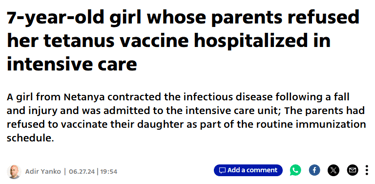
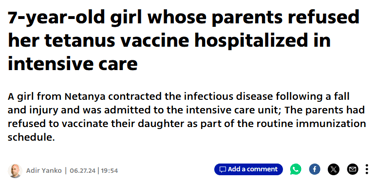
JUNE 2024 a sad reminder of why Tetanus vaccination is super important! 7-year-old girl whose parents refused her tetanus vaccine hospitalised in intensive care
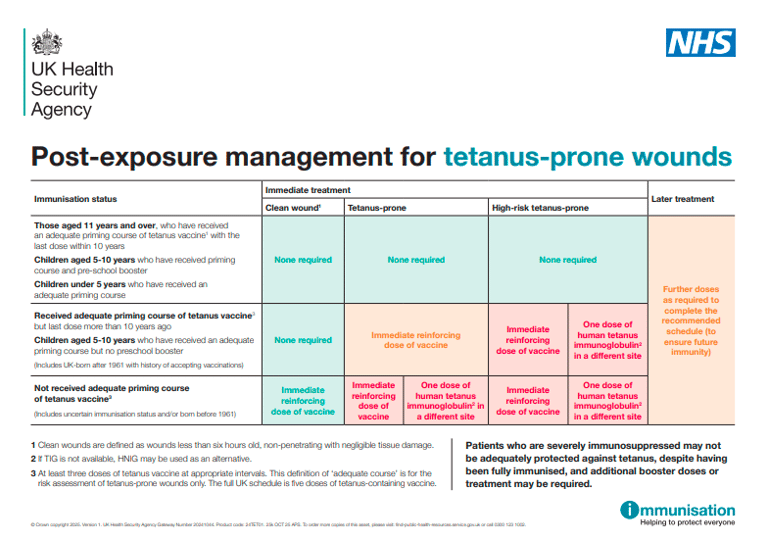
MARCH 2024 Updated guidance for management of tetanus prone wounds
MAY 2023 updated annual surveillance reports added to datasets
Other useful links and further reading
Bits and bobs to casually drop into conversation
Did you know....
According to the CDC:
Wounds without visible contamination can become infected with tetanus spores; tetanus transmission has been associated with abortion, dental infection, injection drug use, otitis media, pregnancy, and surgery.
Neonatal tetanus can be acquired when spores contaminate the umbilical cord due to unhygienic delivery practices. Neonatal tetanus is still common in the developing world where the portal of entry is usually the umbilical stump, particularly if there is a cultural practice of applying animal dung to the umbilicus.
Direct person-to-person transmission does not occur.
In 2020, over 11,750 tetanus cases were reported worldwide to the WHO, of which 2,230 occurred in neonates. Most tetanus cases were reported from countries in Africa and Southeast Asia.
The duration of the incubation period is inversely related to the severity of symptoms, and shorter incubation periods are associated with injuries closer to the central nervous system.
Case-fatality ratios for generalized tetanus vary between 25% and 100% and can only be reduced to 10%–20% where modern intensive care is available. Important bit of information for travellers!
Because the spores exist in the environment, tetanus cannot be eradicated. Tetanus disease does not result in immunity. Other than avoiding ALL possible environmental exposures (not likely feasible), vaccination is the only prevention against tetanus.
Cases of tetanus are known to be under-reported. A comparison of surveillance data against hospital episode statistics in England between 2001 and 2014 suggested that tetanus was under-reported by 88% during that period. There were 67 additional cases identified in the hospital statistics that were not captured through enhanced surveillance